Bill Deverell
Westward expansion:
- consider teaching it not just as "gold was found in CA and everyone headed west." It's not just an inevitable march west, but takes place very, very gradually.
- Most Americans are born, live, and die within about 15 miles of their birthplace. "Looking for land just over the rise, or just beyond the sunset." Looking to be just a little bit better, gain just a little more land; society is mostly farm based.
- Farms grow just enough different products to barely sustain the family (or not). As time passes, farms grow more produce to sell and buy other items (1700-1820).
- The boys are doing the work of men, and the girls are doing the work of women. School, maybe. Tied into the harvest.
- They can oftentimes read and write, but in a rudimentary manner. There's a variety in spelling and writing since there just aren't standards in teaching. Students would often write their name 3 times and numbers; they're very proud of their literacy. Samplers include letters and numbers, as well as the house; shows the women are in charge of the house. Most homes include the Bible, Pilgrim's Progress and Shakespeare (they can act it out). McGuffey's Reader: teach students the alphabet, handwriting, then a small parable. Lincoln does this so well since he was steeped in them growing up. Pastors were preaching that westward expansion would bring about the second coming… not fringe, but mainstream beliefs.
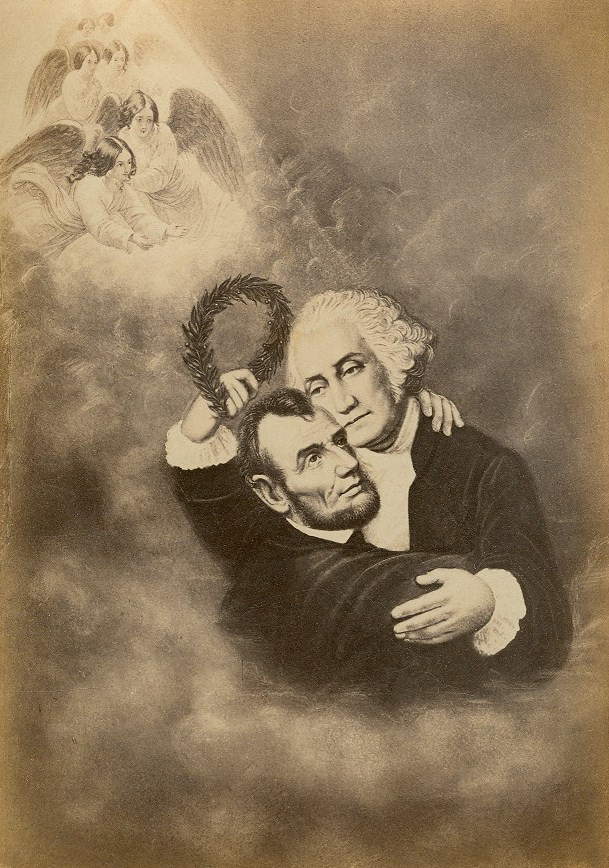
- "Through Washington, great works were done." Washington was a tool/servant of God. At his death, was really honored as a hero. Lincoln died on Good Friday; Washington reaches down from Heaven, pulls him up to sit beside the right hand of God.
- Gettysburg address: focuses on a creation/conception/birth of a new nation; before Washington? The king.
Early Republic:
- Western New York: literate farmers; building institutions of higher learning; we have made sacred the documents of the nation (Bill of Rights, Constitution).
- The Burned Over District (update New York): Rome, Athens, New York: named as a reminder of our inheritance of the old republic. Farm houses had columns as a reminder of their Roman/Greek background. The country is new, and considered fragile.
- Thomas Jefferson: known as very smart, but looking out for #1. Considered a dandy, didn't fight in the war. President in 1800. "Tilling the soil is a noble profession." The new republic will work when the people are familiar with one another. Too big? Anonymity kicks in, and discourages accountability. If the country grows too big, one governing document won't be enough. The Louisiana Purchase doubled the size of America; so did the end of the Mexican War.
- 1803: Lewis and Clark were sent out to find out just how big the country is; take notes on what's there; be good to the Indians; look for "monsters." No one expected them to make it back. Given a Welsh translation book; they think the Indians spoke Welsh. Gone for 2 years, looking for a Northwest Passage. By 1869, the railroad crossed the country. After they return, Jefferson thinks we have more than enough land for everyone, and we'll never run into Indian trouble.
- Plains Indians: taller then the colonists… former idea was that greater height equals superiority. The colonists threw that theory out the window.
- Washington freed his slaves at his death; Jefferson didn't. The slavery issue began to bubble up since people are becoming more educated. Women's moral authority is expanding beyond the house. Concerned about the amount of alcohol men are drinking; also grappling with anti-slavery.
- 1800, the American south: from the pulpit: we know slavery isn't a good thing, but we'll make the best of it. Seen as a "necessary evil." New England starts to be against slavery; the south backs off. The cotton gin cuts down the cost of cotton; 10 men can do the work of 100. New England buys the cotton from the south, processes it, ships off to Europe. William Lloyd Garrison preaches strongly against it, as well as Henry David Thoreau and Ralph Waldo Emerson. "Slaves are not self-sufficient." "Slavery is as if you're holding a wolf by the ears." Can't let go!
- Farmers are overworking their land and their slaves; keep slaves busy or they'll revolt. Cotton is robbing the land of nutrients; the south buys bat guano as fertilizer. They look to expand farming to Central and South America, including slaves; they're fearful their land will give out. Westward expansion = more farms… will the west be slave or free?
- Manifest destiny: God has granted you special rights to expand across the country. Brutal, xenophobic, but it worked. 1773-1883, we had the entire country, from sea to shining sea. "We found the gold because God made it so." The south is a martial culture; great at fighting. The south sent far more soldiers than the north to fight the Mexican War, so they felt the right to make the west slave states. A slave-free west opens the labor market for the average man.
- 1848-52 was the heyday of the gold rush. Americans are celebrating the fact that miners were classless in the gold fields. Quickly, however, class distinctions rose for those miners who come out with a slave; unfair advantage.
- The railroad does two profound things: it creates the northwest passage, and it's a suture to bring the north and south together. It's Godly, and it's healing.
- The triangular trade: Slaves from the west of Africa are brought into NA and the West Indies to process sugar cane and indigo to send to Europe.
Raul Almada
The Temperance Movement:
- The average American was drinking gallons of alcohol a day, which led to the temperance movement.
Heavenly George and Abe:

Maps:
- Lewis and Clark: their first map shows the Rockies, which Jefferson didn't know existed.
- American Slavery Map, 1860: shows the distribution of slaves across the south, pre-civil war.
Finding primary sources online:
- The Library of Congress: very easy to get a card, easy to view original documents, handle without gloves. The Huntington's rules are a lot tougher. For the LOC web page, scroll down slightly, and go through Collection Highlights subtopics. There's also a link called "Especially for Teachers," then go to "Using Primary Sources," then "Finding Primary Sources." Start with Primary Source Sets. Each set collects primary sources on a specific topic, all as easy-to-use PDFs, with historical background information and teaching ideas. Great ones to pull up first: Baseball; Children's Lives; Hispanic Exploration; the Wright Brothers; etc.
- Other great online resources: the National Archives, Stanford History Education Group (SHEG; check out the Reading like a Historian page). You may need an account, but it's free.
- For CA images, Calisphere is an excellent resource.
- Using primary sources in the classroom: Print up and offer a variety of PS photos; students pick; find someone else in the class to share with; great icebreaker for the first week of school.
- Washington's geometry page, age 14 (click to view); his survey page (click to view).
Bill Deverell, continued
- The south: most families possessed only one slave. GWTW plantation with 100s of slaves was very rare. Ask students to put themselves in the place of a 10-11 year old slave, or even a confederate soldier or drummer boy. Would you, as a slave, run away? Would you dodge the draft? Have a student write what happened in the next 10 minutes.
- The Huntington Digital Library: an open access source of items they've chosen to digitize. SoCalEdison images show a great contrast for LA's harmony with nature vs. industrialization. Click here for "Mrs. Mortimer Prepares Dinner for Eight."
- Form and Landscape: Another great photo collection. "For PST (Pacific Standard Time, an art exhibit), the Getty partnered with dozens of cultural and educational institutions to offer a diverse and eclectic array of exhibits and programs."
Raul Almada, continued: more great images:
- Chinese and American gold miners: what's the story here?
- Civil war images: the Liljenquist family collection.
- Waldseemüller map, 1st document to name North America. Here's another link.
Audrey Durden (adurden@huntington.org): School Programs Coordinator, Huntington.


No comments:
Post a Comment